
Lunit – Published on August 11, 2026
AI-STREAM is one of the few prospective breast AI studies to evaluate AI in a single-reader screening environment. The study reported a 13.8% increase in cancer detection without any statistically significant increase in recall rates.
Most prospective breast AI studies, including widely discussed studies such as MASAI and ScreenTrust CAD, have been conducted in double-reading screening programs. AI-STREAM offers a different perspective.
AI-STREAM provides findings from a real-world single-reader screening environment that may be particularly relevant to how U.S. breast imaging practices operate.
Conducted as a prospective, multicenter study in a real-world screening population, AI-STREAM evaluated Lunit INSIGHT® MMG as an adjunctive tool used to support the interpreting radiologist after the initial read, rather than acting as a replacement for physician review.
The study's primary analysis involved experienced breast radiologists with more than 10 years of breast imaging experience. A secondary analysis was conducted involving 5 general radiologists with varying levels of mammography interpretation experience.
The study included approximately 24,500 women participating in breast cancer screening and compared screening performance with and without AI support.
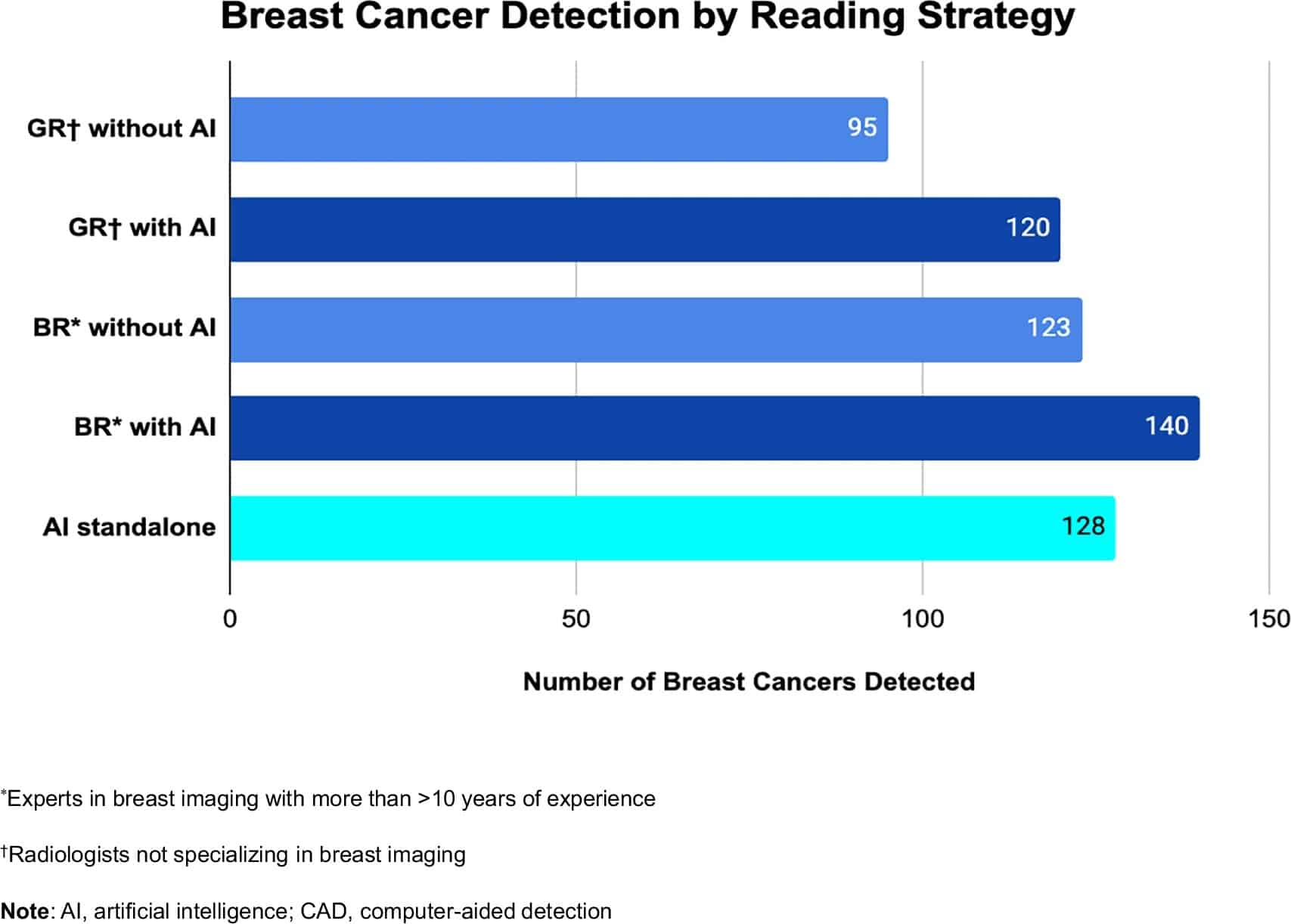
For breast radiologists, the use of AI increased the cancer detection rate by 13.8%, from 5.01 to 5.70 cancers detected per 1,000 screens. That translated to 17 additional cancers being detected across the study population. The positive predictive value for recall (PPV1) also improved from 11.2 without AI support to 12.6 with AI support, a statistically significant increase indicating that recalls were more likely to result in a cancer diagnosis when AI was used.
Just as importantly, this improvement was achieved without a significant increase in recall rates, which remained almost unchanged at 4.53% with AI support compared to 4.48% without it.
A similar trend was observed among 5 general radiologists. With AI support, they detected 120 cancers compared to 95 without AI, resulting in 25 additional cancers being identified. However, for this group there was an increase in recall rates from 6.89% to 6.31% with AI support, potentially due to their lower self-confidence in interpreting mammography compared to specialists.
One of the most important aspects of AI-STREAM is the role AI was asked to play. The study wasn't designed to determine whether AI could replace a radiologist. Instead, it explored whether AI could help the radiologist already responsible for reading the exam.
For many U.S. breast imagers, the question isn't:
"How can I replace my second reader?"
It's:
"How can I find more cancers without increasing recalls or adding another radiologist?"
Prospective breast AI studies are often discussed together, but they aren't always designed to answer the same question.
That doesn't make one study more important than the other. It simply reflects the fact that screening programs don’t all work in the same way.
It's less about deciding which study is better and more about understanding which evidence is most relevant to your practice.
What is AI-STREAM?
AI-STREAM is a prospective, multicenter study evaluating Lunit INSIGHT MMG in a real-world single-reader breast screening environment.
What are the main findings of AI-STREAM?
Among breast radiologists, AI support increased cancer detection by 13.8% without a significant increase in recall rates. The study also reported 17 additional cancers detected across the study population.
How does AI-STREAM differ from studies like MASAI?
MASAI evaluated AI as a triage and read-assist tool in a double-reading screening program, while AI-STREAM evaluated how AI can support the radiologist interpreting the exam in a single-reader screening environment. Because U.S. breast imaging practices operate in a single-reader workflow, AI-STREAM provides prospective evidence relevant to that setting.