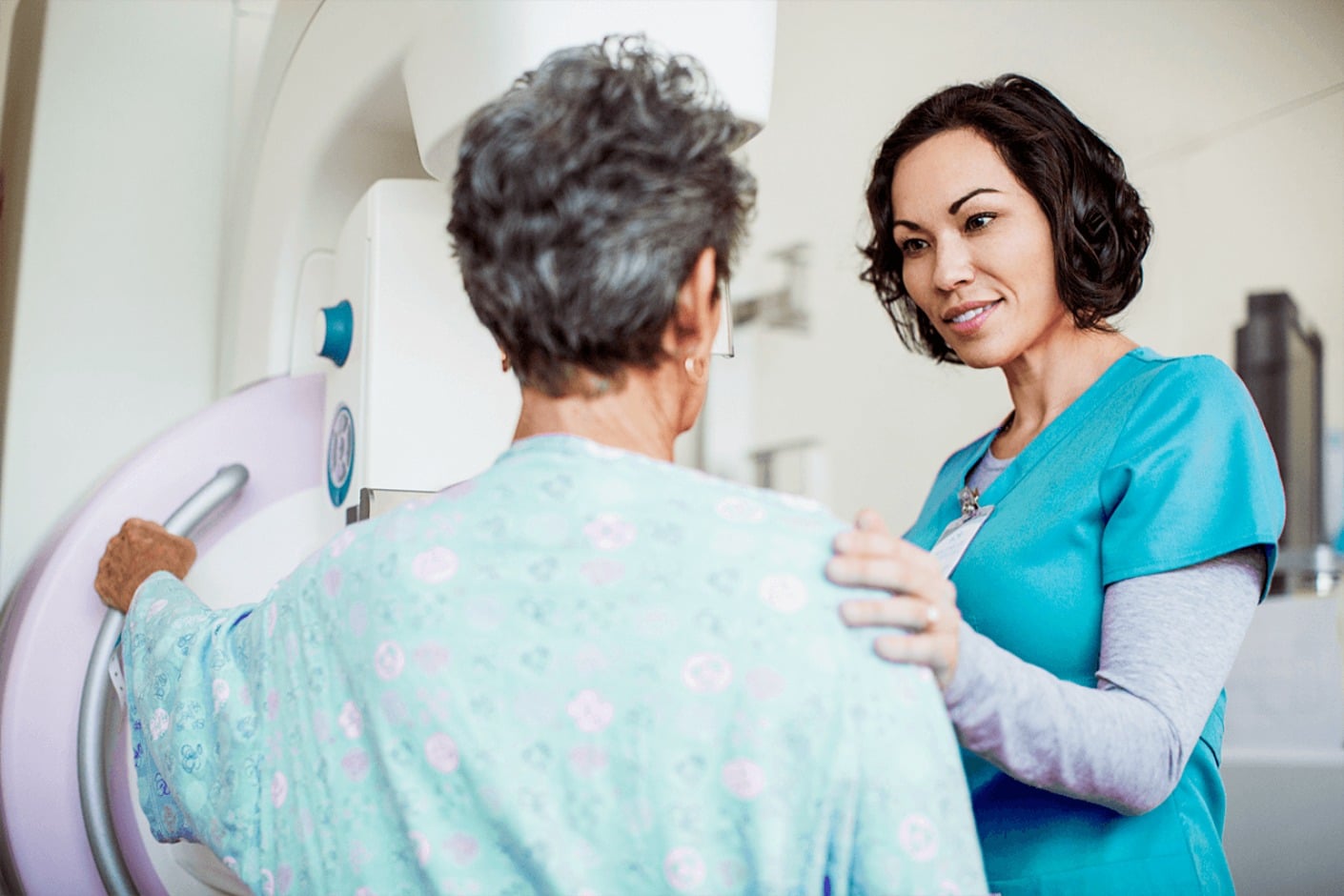
This article explores the findings of a recent study published in Radiology, which evaluated whether Lunit INSIGHT® MMG heatmaps matched the location of cancers later diagnosed as interval cancers.
Many interval cancer studies focus on a single question: would AI have flagged the case?
A recent study published in Radiology explored an additional question: would AI have identified the correct location of the cancer?
Using a subset of 121 interval cancers from the Cambridge screening program, researchers evaluated whether Lunit INSIGHT® MMG heatmaps matched the location of the cancer that was later diagnosed.
Why does localization matter?
Using an AI tool that marks a lesion is one thing.
Using a tool proven to focus attention on the marks that matter is another.
For interval cancers, localization changes the conversation. A mark can draw attention. A correctly localized mark can focus it.
How was the study conducted?
Researchers evaluated a subset of 121 interval cancers from the Cambridge screening program.
The study assessed whether AI heatmaps matched the location of the cancer that was later diagnosed.
A UK-equivalent operating point was used, with 96% specificity, matching a 4% recall rate.*
What did the study find?
Using the selected operating point:
90.1% of flagged cancers were marked on the correct breast.
76.9% were correctly localized.
In 98% of correctly localized cancers, the AI either produced only the correct location or assigned it the highest score.
What do these findings mean?
The study evaluated more than whether AI would have flagged an interval cancer.
It also assessed whether the AI focused attention on the location that was later confirmed as cancer.
These findings help show AI's potential value in screening, not just identifying suspicious cases, but helping direct attention to the marks that matter.
Why is localization important?
When reviewing an exam, identifying a suspicious case is only part of the process.
Localization helps determine whether attention is being directed to the area that ultimately proves clinically significant.
The findings from this study suggest that Lunit INSIGHT® MMG was frequently identifying the correct location among interval cancers included in the analysis.
*These results highlight localization performance. The full paper also includes stratification by cancer visibility and false-positive rates. AI is intended to support radiologist interpretation and is not a replacement for clinical diagnosis.
Read the full paper: Accuracy of an Artificial Intelligence System for Interval Breast Cancer Detection at Screening Mammography - Lunit
FAQ
What was the main question studied?
Researchers evaluated whether Lunit INSIGHT® MMG correctly localized the cancer that was later diagnosed, rather than looking only at whether the case was flagged.
How many interval cancers were included?
The analysis included a subset of 121 interval cancers from the Cambridge screening program.
How often was the correct breast identified?
At the selected operating point, 90.1% of flagged cancers were marked on the correct breast.
How often was the cancer correctly localized?
The study found that 76.9% of flagged cancers were correctly localized.
What happened when cancers were correctly localized?
In 98% of correctly localized cancers, the AI either produced only the correct location or assigned it the highest score.